
Reviewed · CITY TOURS
Cebu City Tour
Cebu’s past is packed into a small part of the city, from the 1675 to 1700 Yap Sandiego Ancestral House to the church linked with the arrival of Christianity in the Philippines. This three-hour private tour connects those places without making you fight Cebu’s traffic on your own.
I like the hotel pickup and private vehicle, which let you step out at each stop and get moving again. I also like the mix of Taoist, Chinese-Filipino, Spanish, and Filipino Catholic sites. The drawback is simple: the tour moves quickly, and some stops last only five minutes, so the $38 price makes the most sense if you value a guide and easy transport rather than a long visit at each sight.
Key points at a glance
- Five compact historic stops: The route covers the Taoist Temple, Heritage of Cebu Monument, Yap Sandiego Ancestral House, Magellan’s Cross, and Santo Niño Basilica.
- Private door-to-door transport: Your group receives hotel pickup, hotel drop-off, and a private vehicle, a useful advantage in Cebu traffic.
- A strong religious and cultural mix: You see a Taoist temple, a Chinese-Filipino ancestral home, and major Catholic sites in one short outing.
- Guide quality matters: The standard package includes a tour guide or coordinator, while a Department of Tourism certified guide is available as an upgrade.
- Fast-paced sightseeing: The scheduled stops range from five to 15 minutes, so this works best as an introduction rather than a slow historical study.
- Good arrival-day option: The short format fits a first day in Cebu, especially if you want an organized look at the city before settling into a longer stay.
Cebu’s old center in three useful hours
This tour is built around contrast. Cebu City is modern, crowded, and spread out, but the route points you toward places tied to Chinese settlement, Spanish arrival, Filipino Catholic devotion, and older domestic life.
You are not simply being driven past landmarks. The guide helps connect them. At its best, the tour explains how Cebu became a meeting place for different faiths and cultures. That matters because several of the stops are small or visually modest. Without context, you could see a cross, a monument, and an old house without understanding why they belong in the same story.
The private format is a practical strength. You travel only with your own group, and the driver can pull up near each stop so you can get out, look around, and return to the vehicle. In Cebu, where traffic can turn a short road journey into a slow one, this saves energy and time.
Still, you should set your expectations correctly. This is a to-the-point city introduction, not a full-day cultural program. The listed schedule gives 15 minutes at the Taoist Temple, 5 minutes at the Heritage of Cebu Monument, 15 minutes at the Yap Sandiego Ancestral House, 5 minutes at Magellan’s Cross, and 15 minutes at the basilica. Traffic, entrances, and the pace of your guide can affect the actual timing.
A few more Cebu trips to weigh up
- Cebu City: Whale Shark Swimming & Kawasan Falls Canyoneering
★ 4.7 · 665 reviews - Cebu City: Bohol Countryside Tour with Loboc Cruise Lunch
★ 4.5 · 488 reviews - Private Cebu & Lapu-Lapu City Tour with Uphill Spots & Lunch at House of Lechon
★ 4.5 · 168 reviews
Beginning at the Taoist Temple in Beverly Hills
The tour opens at the Taoist Temple in Cebu’s Beverly Hills subdivision. Cebu’s Chinese community built the temple in 1972, giving you a look at a part of the city’s cultural life that is very different from the Spanish Catholic sites later in the route.
With about 15 minutes here, you have time for a compact visit and an explanation of the temple’s place in Cebu. The stop works well at the beginning because it immediately shows that Cebu’s identity is not limited to one faith or one colonial chapter.
The short visit is also the main limitation. You will not have the time for an extended examination of the temple complex or a long pause for reflection. I would treat it as an orientation stop, with the guide supplying the background that the schedule cannot provide.
The private vehicle is especially useful here because this temple sits away from the old downtown cluster. You avoid arranging separate transport to a hillside subdivision, then return directly to the historic center.
Reading Cebu’s story at the Heritage Monument
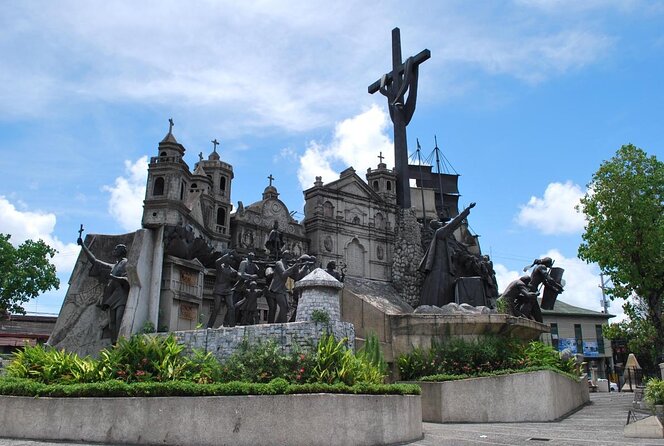
The Heritage of Cebu Monument is a tableau made from concrete, bronze, brass, and steel. Its figures and structures represent events and places connected with Cebu’s past.
Only five minutes are allotted, so this is mainly a photo and explanation stop. You will want to look closely, but the monument contains several scenes and details that deserve more time than the schedule provides. Your guide’s commentary is important here because a quick glance will not explain how the individual figures and buildings fit together.
I like this stop because it compresses a lot of local history into one artwork. It gives you a visual link between the city’s religious sites, old buildings, and political past before you enter the ancestral house nearby.
If you are hoping for a long museum-style visit, this may feel rushed. If you use the time well, it becomes a useful bridge between the broad story of Cebu and the more personal story told by the next stop.
Stepping inside the Yap Sandiego Ancestral House
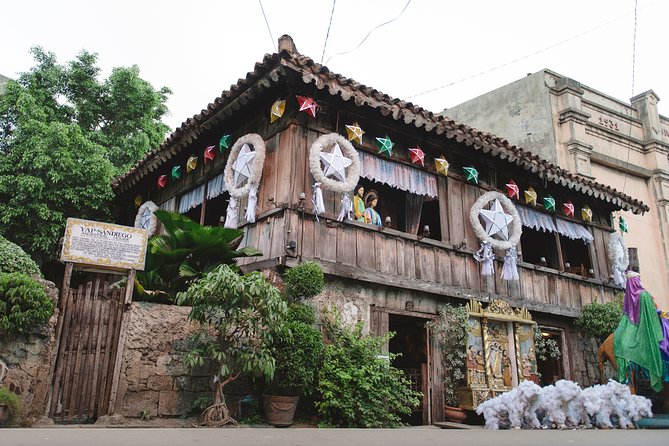
The Yap Sandiego Ancestral House is one of the most distinctive stops on the route. Built sometime between 1675 and 1700, it was originally owned by the Chinese merchant Don Juan Yap and his wife, Dona Maria Florido.
This old merchant home lets you think about daily life rather than only major political events. The house gives the tour a domestic scale. Instead of hearing only about explorers, churches, and colonial power, you get a sense of how a Chinese-Filipino household was connected to Cebu’s commercial and social life.
You have about 15 minutes here. That is enough for an introduction and a look at the interior, but not enough for a leisurely inspection of every antique or architectural feature. I would listen closely to the guide rather than rushing to photograph everything. The point is not just that the house is old. It is the survival of an actual home tied to Cebu’s merchant community.
This is probably the stop that gives the tour its most human feel. The monument explains public history. The ancestral house shows how history reached into private rooms and family life.
Same islands, a completely different day on the water:
- Canyoneering Experience in Kawasan Falls with Lunch
★ 5.0 · 440 reviews - Cebu: Oslob Whale Sharks, Tumalog Falls & Sardine Snorkeling
★ 4.3 · 343 reviews - Cebu: Whale Shark Swim and Kawasan Canyoneering Tour
★ 4.6 · 318 reviews - Cebu: Oslob Whale Sharks, Moalboal Sardine Run & Turtles
★ 4.5 · 266 reviews
Magellan’s Cross and the first Spanish chapter
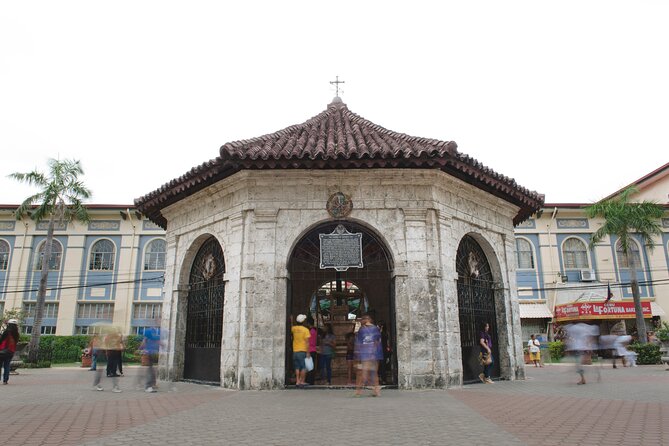
Magellan’s Cross marks the Christian cross planted in Cebu on March 15, 1521, when Portuguese and Spanish explorers arrived under Ferdinand Magellan’s command. The site is brief, with about five minutes planned.
That short timing makes sense for the physical stop, but the story deserves attention. The cross represents the beginning of a major religious and political shift in the Philippines. It is also a reminder that Cebu’s history includes outside powers arriving by sea and reshaping local life.
Because the stop is quick, your guide’s explanation can make all the difference. You may have only enough time for a look and a photograph, so do not expect a detailed historical lecture on-site unless the traffic and schedule leave room for it.
I see Magellan’s Cross as part of a pair with the Santo Niño Basilica. The cross marks the arrival of Christianity, while the basilica shows how Catholic devotion became rooted in Cebu over the centuries.
Entering the Santo Niño Basilica
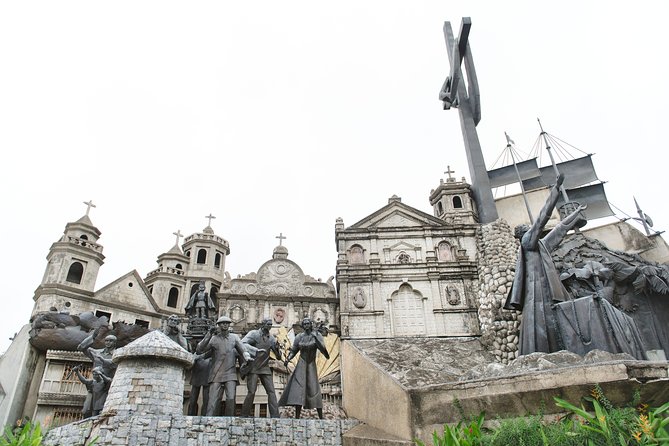
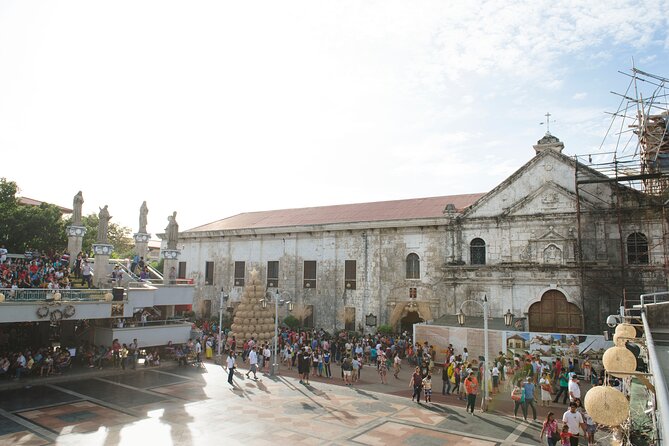
The Basilica Minore del Santo Niño de Cebu is described as the oldest Roman Catholic church in the country. It was built on the spot where the image of the Santo Niño de Cebu was found during the expedition of Miguel Lopez de Legazpi.
This is the most important religious stop on the tour. The church connects the early Spanish period with a continuing Filipino Catholic tradition, and the Santo Niño image remains central to Cebu’s identity.
The visit is scheduled for about 15 minutes, which gives you a short look rather than a full church experience. Church activity may affect how long you can pause, so keep your behavior respectful and follow any instructions from the guide or staff.
Dress modestly for this part of the tour. Sleeveless shirts may not be permitted, so it is wise to wear clothing that covers your shoulders. This small preparation can prevent an awkward stop at the end of the route.
The basilica is a good place to slow down mentally, even if the clock is moving. After the temple, monument, and ancestral house, you can see how the different strands of Cebu’s past meet in a living place of worship.
What the private vehicle really adds
The private transport is not just a comfort feature. It changes how practical the tour feels.
You receive round-trip private transfers, hotel pickup, and hotel drop-off. At each stop, you can leave your bags in the vehicle and return to the same driver instead of negotiating a taxi or ride between every sight.
That matters in a city where traffic is described as difficult. One guide, Vernie, was specifically praised for working with a driver so the two people on the tour could jump out and back in without dealing with the roads themselves. The same arrangement is useful for families, older visitors, and anyone with a limited amount of time.
The trade-off is cost. At $38 per person, this is more expensive than piecing together a few nearby stops on your own, especially for a larger group. But the price includes transport, guide services, activities, taxes, fees, and handling charges. You are paying for coordination as much as for admission.
There is also a group discount option. Since this is a private activity, the value improves when several people share the vehicle and guide. A solo visitor may find the price less compelling, while a couple or small group may appreciate the saved time.
Choosing the right guide option
The base package includes a coordinator or tour guide, and you can upgrade to a Department of Tourism certified guide. This choice deserves attention because the stops are short and the value of the tour depends heavily on explanation.
Angelica is associated with clear commentary that brings the sites to life. Chen has guided the city tour with Josh, and both are named in connection with friendly, informative outings. Vernie is another guide named in the experience feedback.
Guide assignments can vary, so you should not book on the assumption that a particular person will lead your tour unless the provider confirms it. The practical lesson is to choose the certified guide upgrade if understanding the history matters to you. A driver-only or lightly narrated visit could make the itinerary feel like a series of quick photo stops.
The strongest guide will help you connect the sites rather than recite isolated facts. Ask about the Chinese merchant community, the meaning of the Santo Niño, and the difference between Magellan’s arrival and the later Spanish expedition of Legazpi. Those questions fit the route and can make a short tour much more rewarding.
Is three hours enough for Cebu City?
Three hours is enough to get your bearings and see the main historic highlights. It is not enough to study each location at length, browse at a relaxed pace, or add many unscheduled stops.
The schedule can feel like a full half-day because the route combines driving with five visits. The quick changes also suit a first visit or an arrival day when you want something organized but do not have the energy for a longer program.
One useful feature is the hotel pickup and drop-off. You do not need to spend part of the morning or afternoon finding the meeting point, and the return to your hotel keeps the activity easy to combine with other plans.
I would avoid booking it when you want a slow, reflective church visit or a detailed architectural tour. The pace is better for someone who wants a clear introduction and will perhaps return later to the places that deserve more time.
Who will get the best value at $38?
I think the tour suits first-time visitors, couples, families, and people staying in Cebu City who want a simple introduction without planning every transfer. It also works well on the day you arrive, as one person described using the half-day tour for an arrival day while still finding it substantial.
The price is easiest to justify when you value three things:
- A private vehicle in heavy city traffic
- Hotel pickup and drop-off
- A guide who explains why the places matter
The value is weaker if you are already comfortable arranging taxis, know Cebu’s historic center, or mainly want to take photographs. Several stops are close together, and the admission tickets are listed as free, so the fee is primarily for transport, time, and interpretation.
The rating is 4.6 from 11 reviews, with 91 percent recommending the experience. That is a positive result, but the small number of ratings means you should still weigh the one clear criticism: the tour can feel overpriced if you judge it only by the number of sights and the short duration.
Practical details before you reserve
Confirmation is sent at booking, and you receive a mobile ticket. Pickup is offered directly from your hotel, with drop-off included after the tour.
Food and drinks are not included, so plan to eat before or after the three-hour outing. The tour is private, meaning only your own group participates, and most people can take part. Children must be accompanied by an adult, and the child rate applies only when sharing with two paying adults.
You can cancel for a full refund if you do so at least 24 hours before the experience begins. Changes or cancellations inside that 24-hour window are not accepted for a refund. The local time in Cebu controls the deadline, and if the minimum number of participants is not reached, the provider offers another date or experience, or a full refund.
Should you book the Cebu City Tour?
Book it if you want a short, organized introduction to Cebu’s past and do not want to battle traffic or arrange several rides. The private vehicle, hotel service, and guide make the outing especially useful for an arrival day, a family group, or anyone with only a few hours in the city.
Choose the Department of Tourism certified guide upgrade if you care about history and context. Without strong commentary, the five-minute stops at the monument and Magellan’s Cross may feel thin.
Skip it if you want a slow museum visit, a full-day city program, or the lowest possible price. At $38, you are buying convenience and interpretation more than entrance tickets. For the right visitor, that is a fair trade: you see five meaningful places, move through Cebu with less stress, and leave with a clear sense of how Chinese, Spanish, Filipino, Taoist, and Catholic influences shaped the city.
FAQ
How long does the Cebu City Tour last?
The tour lasts approximately three hours. The scheduled visits range from five to 15 minutes, with additional time spent traveling between locations.
What places does the tour visit?
The route includes the Taoist Temple, Heritage of Cebu Monument, Yap Sandiego Ancestral House, Magellan’s Cross, and Basilica Minore del Santo Niño de Cebu.
Is hotel pickup included?
Yes. Hotel pickup and drop-off are included, along with round-trip private transfer by private vehicle.
Is this a private tour?
Yes. Only your group participates in the activity.
Does the price include food and drinks?
No. Food and drinks are not included in the price.
Is a Department of Tourism certified guide included?
The package includes a tour guide or coordinator, and a Department of Tourism certified guide is available as an upgrade.
Can I cancel for a full refund?
Yes. You must cancel at least 24 hours before the experience start time for a full refund. Cancellations or changes made less than 24 hours before the start time are not accepted for a refund.
Just added around Cebu
- Whale Shark Watching & Tumalog Falls & Kawasan Falls★ 5.0 · 16 reviews
- Whale Shark Watching and Sumilon Sandbar Private Tour Package★ 5.0 · 17 reviews
- Whale Shark Watching with Sumilon Sandbar and Kawasan Falls Tour★ 5.0 · 8 reviews
- Cebu Whale Shark Encounter, Moalboal Sardines & Tumalog Falls★ 4.0 · 18 reviews
- Discover Scuba Diving★ 5.0 · 18 reviews
- Full Day Shark Watching and Canyoneering in Cebu★ 5.0 · 15 reviews
- Transfer Cebu City – Bantayan Island★ 3.5 · 4 reviews
- Group Tour of Moalboal Sardines Run & Kawasan Canyoneering★ 4.5 · 9 reviews
City Tours, compared.
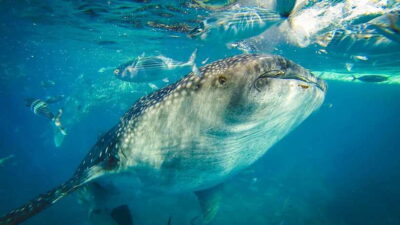
Whale Shark Swimming & Kawasan Falls Canyoneering
Read our review →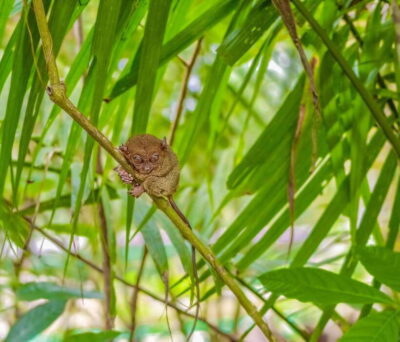
Bohol Countryside Tour with Loboc Cruise Lunch
Read our review →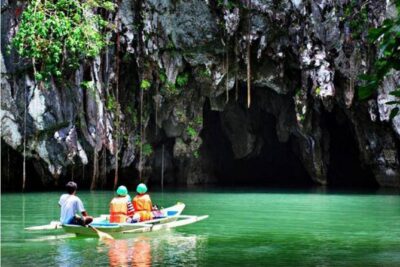
Underground River Day Trip from Puerto Princesa City
Read our review →
Private Cebu & Lapu-Lapu City Tour with Uphill Spots & Lunch at House of Lechon
Read our review →
Bohol Countryside Day Tour From Cebu City | Lunch at Loboc River Cruise
Read our review →
Full-Day Manila City, Tagaytay Taal Volcano and Lake Tour
Read our review →
Manila Ninoy Aquino Airport (MNL) Private Transfer to Manila City
Read our review →Browse the lists this tour appears in